


 LinkBack URL
 About LinkBacks
How does it work in 2d with dual screens, current Nvidias will not idle with dual screens, have they resolved that?

How does it work in 2d with dual screens, current Nvidias will not idle with dual screens, have they resolved that?
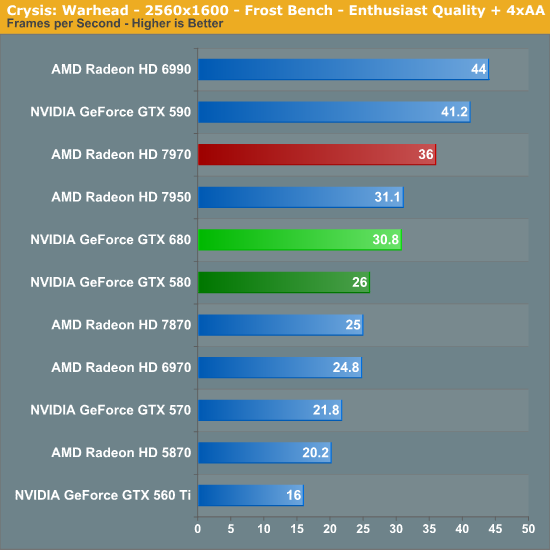
It actually loses heavily to the 7970 in Crysis Warhead, even losing out to the 7950 at 1600pOriginally Posted by DELETED

I understand this, however, even looking at the average disparity between system consumption differences, which is interesting in itself, numbers are significantly different.
It either means that the 680 and its drivers are very good at reducing system activity / pcie load, which rightfully should count to efficiency though understandably not in a debate about die changes, OR perhaps there's a difference between when they're benchmarked and what they're doing? Which given the dynamic under and over clocking of the card is more important than ever.
We know the HEXUS readings were taken during arkham asylum, how might this change during another benchmark I wonder?
That's bandwidth limits for you.
probably a noticeable amount atleast from my theory a few pages back.
Why not use the same game as you have been for the last year(or so?), i must of missed something but it seems a bit silly to suddently change games for a powereffciency bench, especially to an Nvidia sponsored(crippled/hacked etc) which we know involves some dirty tactics.
That's why I wouldn't be surprised to see a larger 685/690 in the future without going as far as dual-chip.
Nvidia have loads of room in that respect so I think you would be right in a 685/90 surpassing it without dual chips. I wonder what AMDs response to this will be? Perhaps they were already working on a beefier version of the 7800 series? I.e a high end card without strong compute capabilities?
Of course AMD could just be spending all their time on their next gen cards, a 4 month headstart (as usual!) would mean AMD are probably likely to come up with a pure tank of a card next year.
TPU uses a range of settings to determine power consumption:
http://www.techpowerup.com/reviews/N...TX_680/25.html
They use Crysis2 under DX11 to test gaming loads and that is very stressful. They are in fact one of the few sites which attempt to measure graphics card power consumption only as opposed to system power consumption.
This is also another point. Even going by the Hexus numbers 15% between the stripped out gaming oriented parts is still not the end of the world for AMD(except for dual GPU cards). Look at cards like the GTX460 when compared to the HD6850?? Yet,in the scheme of things nobody really cared -only the price mattered.
The only people who really care about such things are SFF PC weirdos like me and our obsession with smaller PCs,or those with smaller PSUs.
So a GTX660TI might be what I get as an upgrade eventually.
Well, if you go by US prices MSRP, the 7970 is supposed to be 550USD and the 680 is 499USD. So technically, it's 50 USD or 30 quid cheaper (pre VAT of course) but obviously in the UK we get the stupid tax and hence more is charged for the same product.
We may see overclocked chips but we really don't know how much the 256 bit bus will be a constraint for adding extra shaders.
Moreover,the GK104 is a compute light chip,Tahiti is not. The reason for Nvidia to develop large chips is to replace the GF110 in its Tesla and Quadro high end cards. This is what the GK110 is meant for. This is what the the GF110 was meant for too.
I remember having this discussion with some people who use Nvidia cards primarily(they use things like CUDA and one is an engineer and the other is a maths chap) and they consider that the GK110 will probably not be as efficient gaming wise as the GK104 or GK114 will be. It will be very fast no doubt but there are trade offs and we see it with Tahiti(Pitcairn is around 30% more efficient).
As many people have said,GCN is AMD's Fermi moment(with regards to compute). So hopefully,with the next generation,they can improve efficiency.
In the short term the dual GK104 card is going to no doubt going to beat the HD7990.
I guess it depends if NVIDIA decides to boost the bus along with it. It was interesting to note that the cache was based on the number of 64-bit memory controllers, so the amount of cache doesn't increase with the number of shaders which makes for a potentially efficient increase in die size for compute power over bandwidth. If NVIDIA did increase to 384-bit and maintained a 6GHz clock, it'd likely see the bandwidth it needed, whilst only increasing the cache by 256kb back to fermi levels, which again wouldn't equate to doubling of die size in this area, which sounds promising.
Again,Nvidia would only be developing larger chips for their Quadro and Tesla parts, and TBH I expect them to have additional functionality which will increase the die size,and internally the chip will probably be arranged differently. Even the latest information about the GK110 seems to indicate a 6 billon transistor GPU with 2304 shaders. This is why looking at the GK104 and trying to estimate its size doesn't seem very useful as the GK110 has different design goals in mind.
I wish benchmarks could instead of using AA, use the respective "custom" AA settings that the cards were designed for.
It's the standard AA testing which can sway a test one way or the other, and with them working so hard to perfect their own methods of AA it would be good to see how their work stacks up against the others, rather than relying on MSAA
And this is more of a wish rather than a genuine want, I know it would create unfair scenarios etc. just that does anyone even use the standard AA when they have the choice of the better performing other modes ?
BTW,more news on the rest of the Kepler range:
http://forums.hexus.net/2371201-post523.html
Depends what you mean by performance - even on my 4870 I whack on lots of different AA and AF modes to improve the image quality at the expense of frame rate - but the frame rate drop would show up on a graph while the image quality wouldn't. Best thing is a separate article dedicated to looking at image quality, rather than as part of the first reviews, which aim to compare new graphics models with other ones in as even a way as possible (hopefully).
The problem with comparing each companies respective AA technologies is that they will perform differently, its hard to simply benchmark them using their own tech and so AA is really the middle ground, sure they may not be optimising for it as much as they should but it is the brunt way of showing if bandwidth is an issue etc. A separate review based on comparing the two techs would be a useful one really, as it would be interesting to see how they fair especially compared to the standard AA.
There are currently 1 users browsing this thread. (0 members and 1 guests)
 Posting Permissions
