

 LinkBack URL
 About LinkBacks
I was curious just how much room temperature can affect the temperature of the PC. I chose to look at the CPU since Speedfan can monitor and log temps for each of the 4 cores in my Q6600, and since of all the components, the CPU is probably the most sensitive to changes in air temp. since mine is air cooled.
Anyway, I did the same x264.exe encode that I have been doing for all my temperature comparisons and monitored room temp. with a calibrated digital thermometer at several points during each encode. These were averaged and graphed against the averaged reported core temp* values from Speedfan for the entire second pass of a 2-pass x264 encode of the same video file. I was happy to see that for the different room temps used, the increases were pretty linear (certainly within error).
Result:
You can see by the slopes of the regression line that every delta °F of room temp. affected the average core temp by about 0.8 °C and for your Celsius folks, every delta °C of room temp. affected the average core temp by about 1-1/2 °C.
So what does this mean and why do you care? Well, using these rules of thumb, if it's currently 70 °F in your room, and your average load core temp is 65 °C, you can expect that to change by roughly 0.8 °C for every single °F your room temp. change. Say your room hits 80 °F. Your load core temp should increase from 65 to 73 °C which may be unacceptable to you and you might want to adjust your o/c accordingly. This is just an approximation based on my system. Your mileage may vary...
*The numbers I used are equivalent to those collected by TAT or RMClock: these temps are core temps. As I understand it, TJunction never changes and is a fixed value for a given chip. The Quads get a values of 100 °C and the duals get 85 °C. The core temp is defined as:
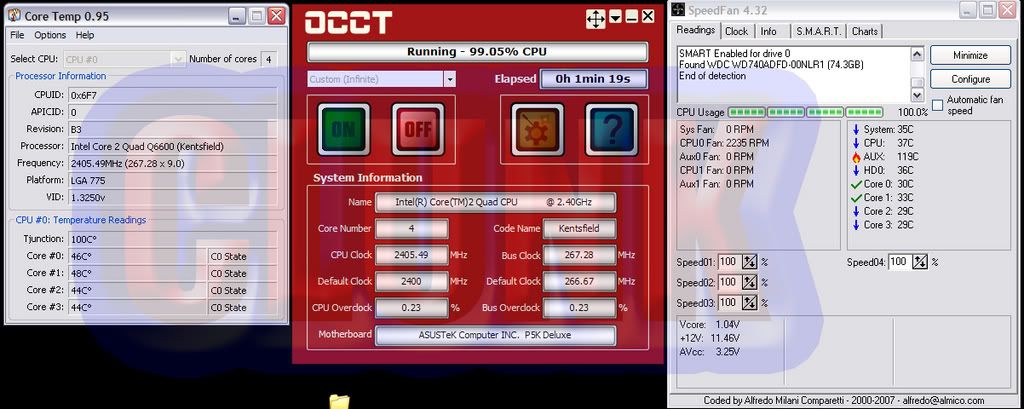
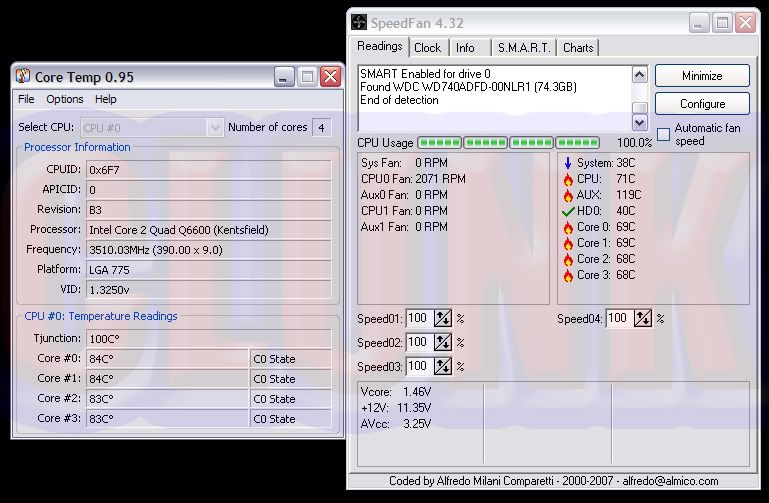
DTS (Digital Thermal Sensor) can be read directly for each core. See this thread for more on reading your DTS directly without software like TAT or RMClock paying attention to uncleweb's posts using crystalCPUID to read the DTS directly. When I tried this method, I was able to get the same values for the core temps on my Q6600 as TAT and RMClock gave me. For some reason, Speedfan always shows cooler core temps for my chip which I corrected by adding 15 °C to each temp (the table is CORRECTED temps). Read more about that in the caption under the graph.Code:Core temp = TJunction - DTS Example, DTS reads 62. You take 100-62=38 and your core temp is 38 °C.
Raw data and graphs
Hardware specs: Q6600 (lapped) @ 9x333, Ultra-120 Extreme (lapped), P5B-Del., P182 case w/ 4 fans on low, Corsair 620HX, Ballistix DDR2-800 @ 4-4-4-12 (1:1 Mem:CPU).
Raw data table in case you want the individual points:
Downloads and References
To download crystalCPUID: http://crystalmark.info/software/Cry...D/index-e.html
To download rmclock: http://cpu.rightmark.org/products/rmclock.shtml
To download speedfan: http://www.almico.com/speedfan.php
To download TAT: http://www.techpowerup.com/downloads/392/mirrors.php
To read more about TJunction and for a discussion about other things relating to thermal output fromC2D chips, see: http://forumz.tomshardware.com/hardw...topic&t=221745




 Reply With Quote

 Originally Posted by Blitzen